
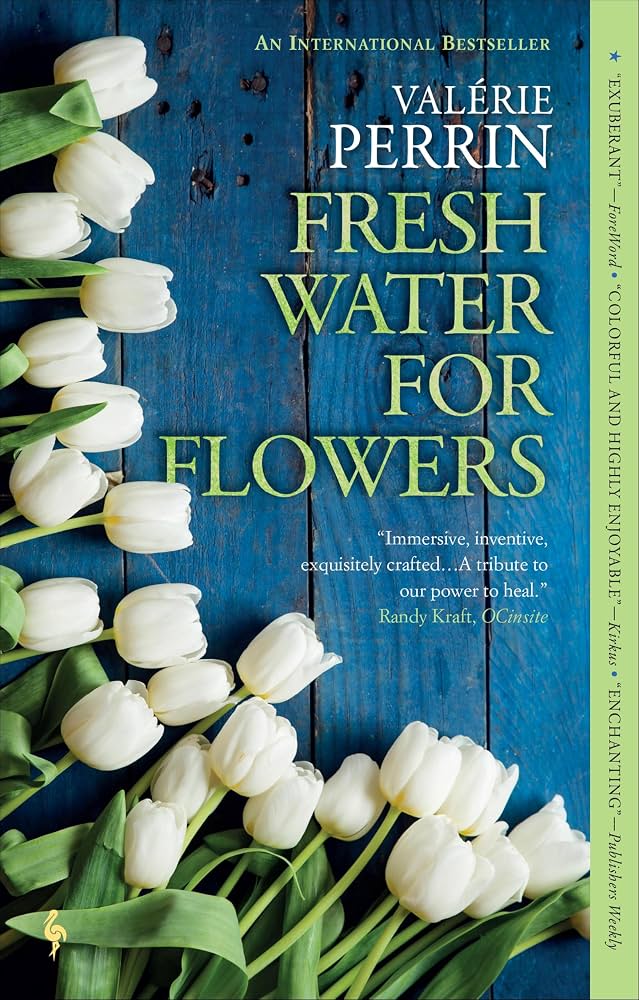
Book Review · Fiction · Valérie Perrin
My favorite quote: “Since I have been tasting life, I offer myself a piece of it every day. I drink it like a drop of tea.”
I picked up Fresh Water for Flowers expecting a simple story about a cemetery keeper. What I found was a profound meditation on life, loss, and the art of starting over. As someone who appreciates the deeper, quieter currents of existence, this book felt like a conversation with a kindred spirit.
A woman who lives among the departed
The story follows Violette Toussaint, the keeper of a small cemetery in a provincial French town. She lives in a world of mourning, yet she radiates an incredible, quiet strength. Her days are made of small rituals: opening the gates, tending the graves, changing the water in the flowers, and listening to the visitors who come to talk to the people they have lost. Over time, the cemetery stops feeling like a place of endings and becomes something closer to a village, with its regulars, its gossip, its small kindnesses, and its own gentle sense of humor.
Watching Violette move from a life of hardship to finding solace among the graves, tending to the flowers and the stories of the deceased, was hauntingly beautiful. She doesn’t just look after the dead. She keeps their stories alive.
The mood is quintessentially French: melancholic yet hopeful, like a rainy afternoon that ends in a golden sunset. Perrin writes with a tenderness that never turns sentimental. Grief sits next to ordinary life here, next to coffee, neighbors, and the changing seasons, and the book never pretends one cancels out the other.
Resilience, and the water we choose to change
What touched me the most is Violette’s resilience. She is the ultimate survivor. The title carries the whole idea: no matter how stagnant or “cold” our water becomes, we always have the power to change it. That doesn’t mean forgetting what hurt us. It means choosing, again and again, to bring in something fresh.
This resonated with me because I am building a new life far from where I grew up. Starting over is rarely one dramatic moment. More often it is a small daily act, like offering yourself a piece of life each day, as in the quote above.
The way Perrin weaves the past and present together kept me turning the pages. Pieces of Violette’s history surface slowly, and the arrival of new people in her life stirs up questions she has long kept buried. It’s not just a literary novel; it’s a puzzle of hearts and secrets, and the pieces fit together with real emotional payoff.
How it changed the way I see death
The book challenges the way we look at death. Instead of a frightening end, the cemetery becomes a place of memory, growth, and even joy. I closed it feeling less afraid of loss, and more aware of how much of our lives is made of the people we carry with us. Most of us are taught to keep death at arm’s length. We lower our voices around it, we avoid the word, we hurry past the cemetery gates. Perrin does the opposite. She puts us at the very center of a cemetery and asks us to stay a while. And the longer I stayed, the more the fear loosened its grip.
In Violette’s cemetery, the dead are not gone in the way I had always imagined. They are spoken to, remembered, argued with, and missed out loud. Visitors arrive with flowers, but also with news, complaints, and confessions, as though the person beneath the stone were simply in the next room. Nobody here treats grief as a problem to be solved quickly. It is allowed to be slow, and it is allowed to sit beside a joke or a cup of coffee. The book showed me that mourning and living are not opposites. They share the same garden.
What stayed with me most is the idea that a person’s life doesn’t end at the last page of their story. It continues in the habits they handed down, the sentences we still repeat in their voice, the recipes, the songs, the small ways we still do things because they once did. We are, in a very real sense, built from the people who loved us and the people we loved. Loss does not erase that. If anything, loss reveals how much of them is still in us.
That thought changed something quiet in me. I used to think of grief as pure subtraction: someone leaves, and you are left with less. This book offered a gentler arithmetic. Yes, something is taken. But what the person gave you stays, and it keeps growing in the way you treat others, in what you notice, in what you choose to protect. Memory, tended with care like Violette tends her flowers, can be alive rather than painful.
And then there is the joy, which surprised me most. Not a loud joy, and never a denial of sorrow, but the kind that appears when we stop running from death and start paying attention to life. The cemetery keeper knows better than anyone how short our time is, and instead of making her bitter, it makes her attentive. She notices the light, the seasons, the small pleasures of an ordinary day. I think that is the real gift of the book: it doesn’t ask you to stop fearing death by force. It invites you to love the present so fully that fear has less room.
I closed it feeling less afraid of loss. Not because loss hurts any less, but because I understood that love doesn’t disappear when someone does. It simply changes address, and we carry it with us.
Who should read it
This is a book for the dreamers, the observers, and anyone who has ever had to rebuild themselves from the ground up. It reminds us that even in the darkest soil, something beautiful can grow if given enough care and “fresh water.”
If you love stories that are slow-burning, emotionally complex, and beautifully written, please do your soul a favor and read this.
A note: it deals with grief, loss, and some heavy themes, so read it when you have room in your heart for it. A cup of tea nearby helps.
Until next post,
Thuy




Leave a Reply